.svg&w=256&q=75)

Pilot Scoping Template and Acceptance Criteria That Prevent AI Shelfware for Project Success

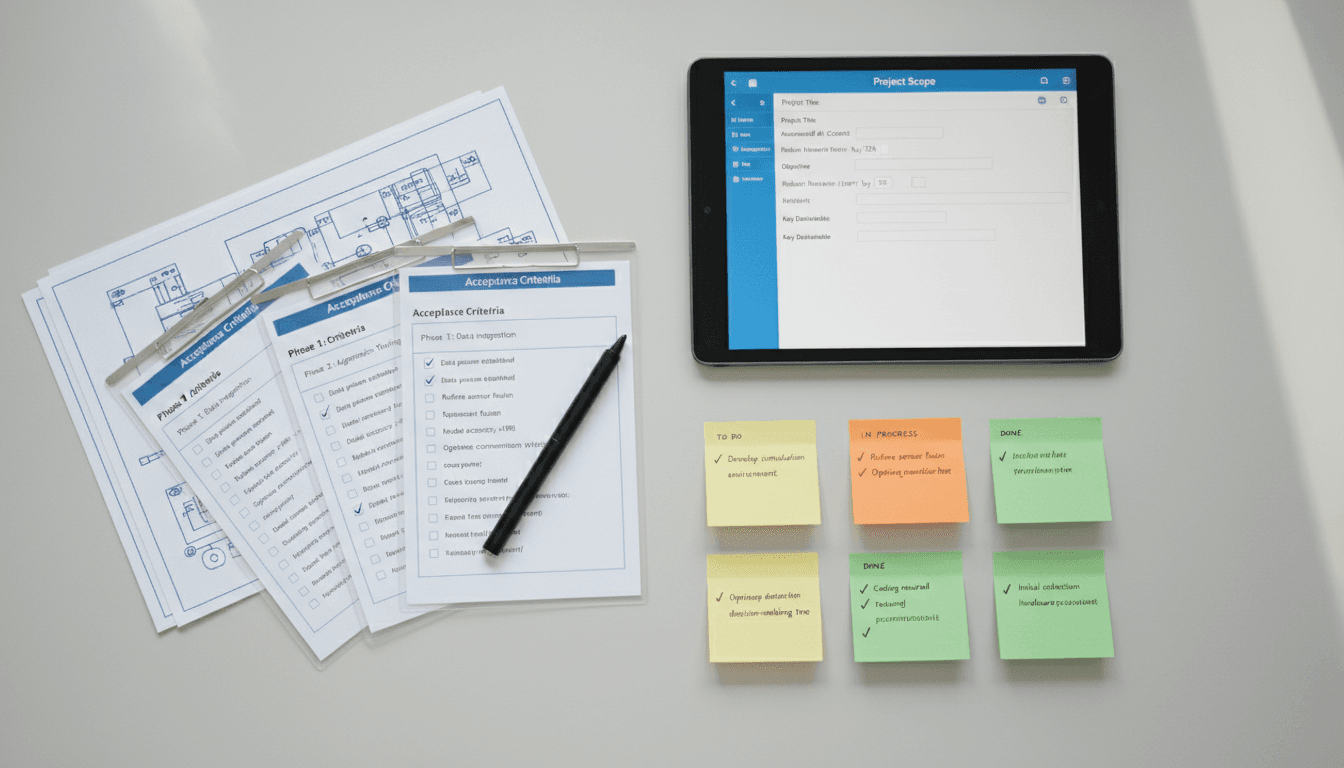
Pilot Scoping Template and Acceptance Criteria That Prevent AI Shelfware for Project Success
The majority of AI pilot projects never make it to production. Industry research consistently points to a failure rate between 80 and 90 percent -- not because the technology does not work, but because the pilots were poorly scoped from the start. The result is AI shelfware: proof-of-concept systems that demonstrated technical feasibility in a controlled environment but could not survive contact with real data, real users, and real operational constraints.
This article provides a concrete pilot scoping template and acceptance criteria framework that enterprise teams can use to dramatically increase the odds of a pilot transitioning to production. These are not theoretical frameworks. They are the patterns we use at Future.works when helping B2B enterprises move from idea to working system.
Why AI Pilots Become Shelfware
Understanding the failure modes is the first step to preventing them. AI pilots typically fail for a small number of predictable reasons:
-
The problem was too vague. A pilot scoped as "use AI to improve customer experience" has no measurable target. Without a specific, bounded problem statement, the team cannot define success, and stakeholders cannot evaluate the outcome.
-
The data was not ready. Many pilots assume data availability and quality that does not exist. The team spends most of the pilot timeline cleaning, integrating, and transforming data rather than building and validating the solution.
-
Production constraints were ignored. A model that runs on a data scientist's laptop with a curated dataset is not the same as a system that handles production traffic, integrates with existing infrastructure, and meets latency and reliability requirements.
-
No one defined what "good enough" looks like. Without explicit acceptance criteria, the pilot ends with a demo that impresses in a meeting room but has no clear path to deployment. Stakeholders cannot make a go/no-go decision because there is no framework for the decision.
-
The business case was an afterthought. Technical teams build the pilot, then try to retrofit a business justification. By that point, executive sponsors have moved on to other priorities.
The Pilot Scoping Template
Use this template as a structured document that every pilot must complete before any technical work begins. Each section forces the team to make explicit decisions that prevent the most common failure modes.
1. Problem Statement
Define the specific business problem the pilot will address. This is not a technology description -- it is a business outcome statement.
- Current state: What is happening today? Quantify the pain (cost, time, error rate, customer impact).
- Desired state: What does success look like? Be specific and measurable.
- Scope boundaries: What is explicitly out of scope for this pilot? Defining boundaries is as important as defining the problem.
- Stakeholder impact: Who is affected by this problem and who will use the solution?
2. Success Metrics
Define three to five measurable outcomes that the pilot must demonstrate. Each metric needs a baseline (current performance), a target (minimum acceptable improvement), and a measurement method.
- Primary metric: The single most important indicator of pilot success. Example: reduce manual document review time from 45 minutes to under 10 minutes per case.
- Secondary metrics: Supporting indicators that validate the primary metric is not being achieved at the expense of something else. Example: maintain accuracy above 95% while reducing review time.
- Guardrail metrics: Thresholds that must not be violated. Example: false positive rate must not exceed 2%.
3. Data Requirements
This section prevents the most common pilot killer -- discovering data problems after work has begun.
- Data sources: List every data source the pilot requires, including owner, format, access method, and current quality assessment.
- Data volume: How much data is available for training, validation, and testing? Is it sufficient?
- Data quality assessment: For each source, document known quality issues (missing values, inconsistencies, staleness).
- Data access timeline: When will the team have access to each source? What approvals are needed?
- Privacy and compliance constraints: What regulations apply to this data? What anonymization or access controls are required?
4. Architecture Constraints
Define the technical boundaries that the pilot solution must operate within to be production-viable.
- Integration requirements: What existing systems must the solution connect to? What APIs or data formats are required?
- Performance requirements: Latency targets, throughput requirements, availability expectations.
- Infrastructure constraints: Must the solution run on existing infrastructure? Are there cloud provider requirements? Security or network restrictions?
- Technology constraints: Required or prohibited technology choices (e.g., must use approved ML frameworks, cannot use external APIs for data processing).
5. Timeline and Milestones
A pilot without a fixed timeline expands indefinitely. Define a compressed schedule with explicit milestones.
- Total duration: Recommend 6 to 8 weeks maximum. Longer pilots accumulate risk and lose stakeholder attention.
- Week 1-2: Data acquisition, environment setup, baseline measurement.
- Week 3-5: Model development, integration, iterative testing.
- Week 6-7: User validation, performance testing against acceptance criteria.
- Week 8: Results presentation, go/no-go decision.
6. Team and Roles
Define who is responsible for what, and ensure the right expertise is available.
- Executive sponsor: Who has budget authority and will make the go/no-go decision?
- Technical lead: Who is accountable for the solution architecture and delivery?
- Data owner: Who can authorize data access and validate data quality?
- Domain expert: Who provides subject matter expertise and validates outputs?
- End users: Who will test the solution and provide usability feedback?
The Acceptance Criteria Framework
Acceptance criteria are the bridge between a pilot and a production decision. Without them, the go/no-go conversation becomes subjective and political. With them, the decision is evidence-based.
Functional Acceptance Criteria
These validate that the solution does what it is supposed to do:
- The system correctly processes the defined input types (documents, transactions, images, text) with the expected output format.
- Edge cases identified during scoping are handled gracefully -- the system either processes them correctly or flags them for human review.
- Error handling is implemented -- the system does not fail silently or produce misleading outputs when given unexpected inputs.
- The solution integrates with the specified upstream and downstream systems as defined in the architecture constraints.
Performance Acceptance Criteria
These validate that the solution performs at production-acceptable levels:
- Model accuracy meets or exceeds the target metric on the held-out test set (not the training data).
- Inference latency is within the defined threshold under expected production load.
- The system handles the expected concurrent user or request volume without degradation.
- Resource consumption (compute, memory, storage) is within the defined infrastructure budget.
Integration Acceptance Criteria
These validate that the solution works within the existing technology ecosystem:
- Data flows from source systems to the AI pipeline without manual intervention.
- Outputs are delivered to downstream systems in the correct format and within latency requirements.
- Authentication, authorization, and audit logging meet enterprise security standards.
- The solution can be deployed, updated, and rolled back using existing CI/CD and intelligent systems integration processes.
User Adoption Acceptance Criteria
These are often overlooked but are critical for production success:
- End users can complete their workflow using the solution without additional training beyond a 30-minute onboarding.
- User satisfaction scores (measured through structured feedback) meet the defined threshold.
- The solution reduces the targeted workflow time by the defined percentage.
- Users trust the system enough to rely on its outputs for decision-making (measured through adoption rate during the validation period).
The Go/No-Go Decision Matrix
At the end of the pilot, use a structured decision matrix rather than subjective evaluation:
- Green (proceed to production): All primary and guardrail metrics met. Integration and performance criteria satisfied. User adoption targets achieved. Clear path to scale.
- Yellow (proceed with conditions): Primary metric met but secondary metrics partially met. Known issues identified with clear remediation plans. Business case still holds with adjusted timeline or scope.
- Red (do not proceed): Primary metric not met. Data quality or availability issues that cannot be resolved within a reasonable timeframe. Architecture constraints that would require fundamental redesign for production.
The matrix removes emotion from the decision. A pilot that hits red is not a failure -- it is a successful experiment that prevented a much larger investment in something that would not work.
Transition to Production Checklist
For pilots that earn a green or yellow decision, the transition checklist ensures nothing falls through the cracks:
- Operational runbook documenting deployment, monitoring, alerting, and incident response procedures.
- Model monitoring in place to detect accuracy degradation, data drift, and performance anomalies in production.
- Retraining pipeline defined and tested, including data refresh schedules, model validation gates, and rollback procedures.
- Security review completed, including penetration testing, access control validation, and compliance sign-off.
- Cost model validated with production-scale estimates, not pilot-scale costs extrapolated.
- Support model defined -- who handles issues, what is the escalation path, what are the SLAs.
From Pilot to Production, Repeatably
The difference between enterprises that successfully deploy AI and those that accumulate shelfware is not technology sophistication. It is discipline in scoping, measuring, and deciding. The template and criteria framework in this article give your team a structured, repeatable approach to AI and digital product pilots that produce clear, actionable outcomes.
If your organization has experienced AI pilot failures or is planning a new initiative and wants to get the scoping right from the start, book a free strategy session with our team. We will help you define the problem, scope the pilot, and establish acceptance criteria that lead to a confident production decision.
Future.works helps B2B enterprises move from AI ambition to production systems through disciplined scoping, rapid execution, and measurable outcomes. Explore our services to learn more.