.svg&w=256&q=75)

AI
In 2023 we proved the AI-native professional services firm, years ahead of the category
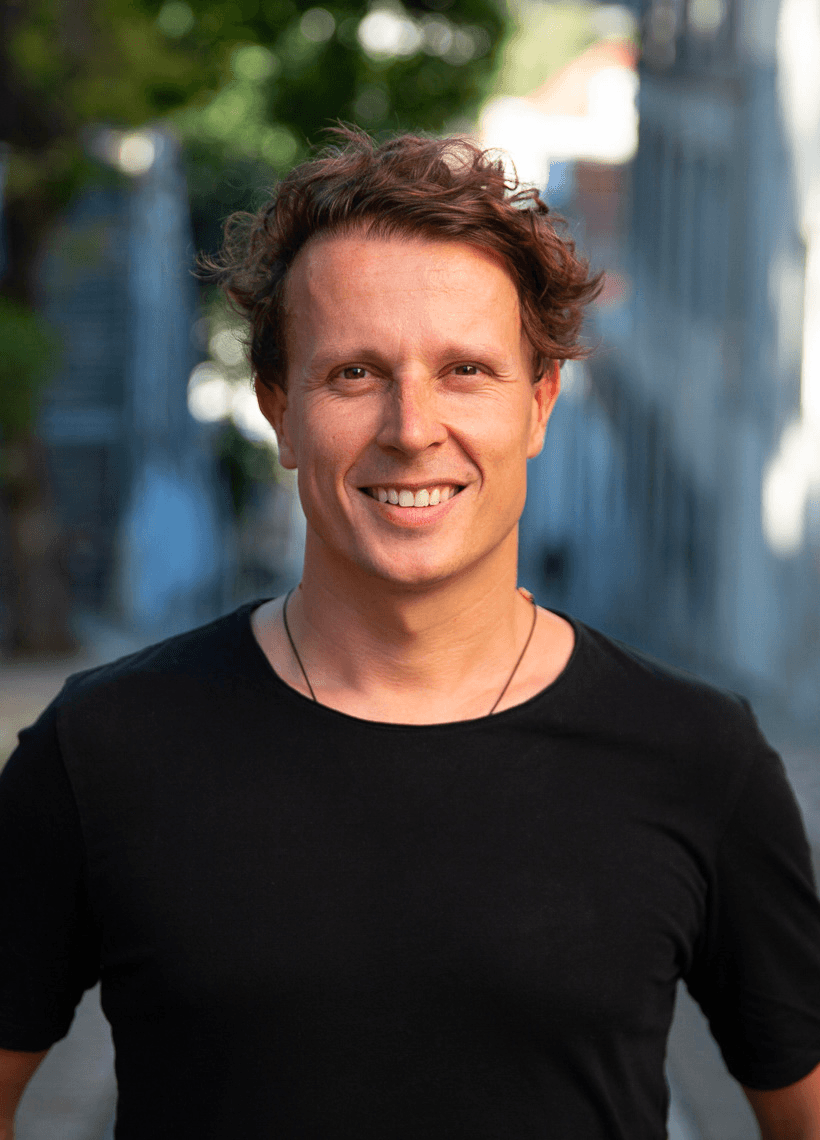

In March 2023, two weeks after GPT-4 shipped, I gave myself thirty workdays, a budget of zero dollars, and one rule: build a company in public with an AI as my cofounder.
It was a side experiment. I was running another company at the time, and these thirty days were carved out of the edges of a full calendar. No team on payroll, no outside capital, no plan beyond a question I could not put down. I posted every day of it under the #HustleGPT tag, wins and faceplants alike, and let anyone watch.
Three years later, that experiment has a name: Future Works. The question I was testing, before the market had words for it, was whether a professional services firm could be built AI-native from the first day, with AI at the core of the work and even in its leadership, and still win real business. It could. The project stayed a side bet through 2023. In 2024 I made it my focus. This is the story of those thirty days and what they proved.
The bet
The setup was simple, which is different from easy.
GPT-4 had been public for about two weeks, and everyone could feel that something had moved. I had a more specific reason to pay attention. By then I had spent six years working with AI and machine learning, mostly on models that did one narrow thing well. This was the first one you could hand an open-ended business problem and get back thinking worth arguing with.
I had six years of AI and machine learning work behind me, and for the first time here was a model you could build workflows and end-to-end orchestration around. That is where this journey started.
So I made GPT-4 my cofounder, not my tool. A strategic thinking partner. Positioning, naming, pricing, outreach, the deck, the follow-up: every decision ran through the two of us, and it changed my mind often enough that the credit is honestly shared.
I set a target that was slightly ridiculous on purpose. A ridiculous goal changes how you work. You stop polishing and start shipping, because polishing your way to a number that big is impossible and you know it going in.
The tweet that started it
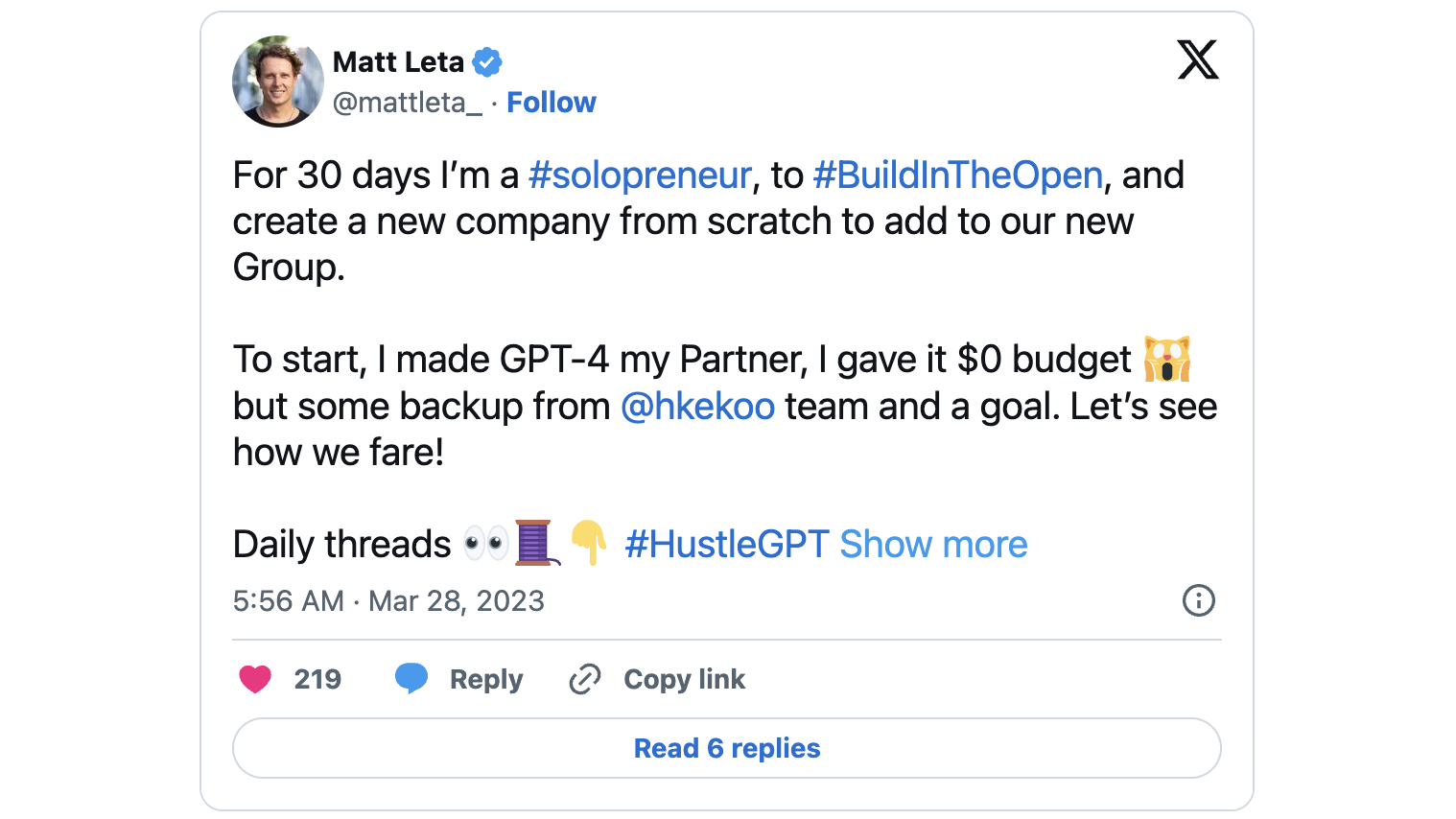
On March 28, 2023, at 5:56 in the morning, I posted this. Thirty days as a solopreneur. Build it in the open. Create a new company from scratch. GPT-4 as partner, zero budget, a goal, and a line I still like: "Let's see how we fare."
I hit publish before I had a plan I trusted. That was the point. Building in public removes the option to quietly give up. Once a few hundred people are watching, the cost of stopping goes up, and the pressure turns into fuel instead of dread. It also keeps you honest. You cannot quietly rewrite the story when the story is already posted.
Thirty workdays, about thirty hours a week
Day thirty, as I reported it at the time: about $1.32M of identified pipeline, $20K of revenue already delivered, and 23.9K new followers. Roughly thirty hours a week, spread across forty-two calendar days.
I want to be careful with those numbers, because pipeline is a promise, not a bank balance, and a month of AI-assisted work does not print revenue on demand. What I can add now, three years out, is that the promise converted. That side project converted into real revenue in its first year, while my main job was still running another company.
One deal from that month tells the story better than the totals. A conversation from the thread turned into a branding, narrative, and investor deck package that my AI partner and I delivered in nine days. The client used it to help raise more than $10M. Nine days of work, sitting inside a raise two orders of magnitude larger. That ratio is the thing I could not stop thinking about.
Strip the numbers away and the real result was quieter and bigger. One person, working with an AI partner through a tight process, could stand up something that looked and delivered like a professional services firm, and win serious work with it. In March 2023, almost nobody was doing that in the open.
That was the real finding of the thirty days: a professional services firm with AI at its core, and even in its leadership, was no longer a thought experiment.
What held true
Most of what I wrote in those daily threads has aged well. A few lessons in particular have only gotten sharper.
AI is a partner, not an assistant. The people who got the least out of these models treated them like faster autocomplete. The people who got the most handed over real problems and let the model push back. The relationship, not the prompt, is where the value lives.
Process runs the whole thing. A great model with a sloppy process gives you sloppy output faster. What made the thirty days work was a repeatable loop: define the outcome, load the context, generate, critique hard, ship, watch what the market did, feed that back in. The loop was the product long before I understood that it was.
Mindset beats tools. Everyone had the same GPT-4. The difference was whether you believed a person with no budget could go and build something anyway. I have watched that single belief separate the people who ship from the people who wait, in every year since.
Expect failure as the default. Most of what I tried in those thirty days did not work. Cold messages ignored. Ideas that sounded brilliant at 6am and looked embarrassing by noon. The plan was never to avoid failure, it was to fail fast enough that the wins had room to show up.
What I underestimated
Plenty of what I believed that month did not survive three years of actually running the company. Three things stand out.
I called it "AI as a partner," and even that was too small. In 2023 the frontier was one model acting as a sounding board for one person, and I assumed the next step was smarter models. The real step was orchestration: a few agents working under one operator, then dozens. By 2026 the unit of work is a senior operator directing a fleet of agents and standing behind what comes back. The shape of a services team changed more in three years than in the previous thirty.
In 2023 the frontier was one model as a sounding board. In 2026 it is senior operators running fleets of agents and vouching for what comes back.

I also looked for the advantage in the wrong place at first. GPT-4 was the most public technology on the planet; within months, hundreds of millions of people were using the same model I was. Access was never going to separate anyone. What separated us was everything wrapped around the model: the process, the context it worked from, the checks on its output, and the reps that come from running real client work through it week after week. That wrapper is what grew into Future Works. Everyone had the engine. We spent three years building the car.
And I treated building in public as a growth tactic, when it quietly became something more durable. Those 23.9K followers were the start of a funnel that still sends us conversations today. The threads also became a public, timestamped record that we were doing this in March 2023, which matters more now, with every firm claiming an AI story, than it did then.
From one AI partner to a fleet of agents
The experiment became a company, and the company grew up in two stages. Through 2023 it stayed a side project: real clients, real revenue, but my calendar belonged to another business. In 2024 I made Future Works my focus, and that is when it stopped behaving like an experiment.
Future Works today is an AI-native transformation operator. We are self-funded, and we deliver at enterprise scale in health-tech, commercial real estate, and energy. No outside capital, by choice. The discipline that comes from starting with zero dollars is written into how we run.
We were early to the thing the whole professional services industry is now scrambling toward: a firm built AI-native from the first day, rather than a traditional firm bolting AI onto the side of an old operating model. The distance between those two is the whole game, and we have a three-year head start on running it in production.
The last three years also taught a simpler lesson. Models kept improving faster than organizations could absorb them, so the scarce resource stopped being capability and became senior judgment: people who can point these systems at the right problem and answer for the result. That gap is why so many large companies are still stuck in pilots, and closing it is the business we are in.
The line back to 2023 is exact. Then it was me and one model, run through a tight process, out in the open. Now it is senior operators running fleets of agents on our own harness, inside real enterprise operations, with fees staked on the outcome instead of the hours. Same idea, more force. The part that never changed: one accountable human owning the outcome, with AI doing a serious share of the work.
What I tell executives starting the same journey
This part is easy to misread as a startup story, so let me be precise about what it actually was. By March 2023 I had spent nearly a decade building fast-growing professional services businesses. I had a model that worked. What the experiment forced me to face was that my own industry had started to turn, and that defending the model that worked, the move that looks safest, was the risky one. So I transformed early, while the change was still cheap.
That is the position every executive I work with is in right now. You run something that works, in an industry AI is rewriting underneath you, and the question is not whether to move but when. Three things made our early move work, and they are the same three I give any leader facing that call.
A clear owner and leader. Not a committee, not a steering group with rotating attendance. One person with the authority to decide and the obligation to answer for the result. In the experiment that was me by default. Inside a large company you have to choose that person deliberately, and choosing four people is the same as choosing nobody.
Start. Waiting for the perfect data, the perfect model, or the perfect plan is the expensive choice dressed up as the safe one. We started with a two-week-old model and zero dollars.
Do not stop. This is the one I lean on hardest in my talks and in my book, because it is where transformations actually die. Almost every leader manages to start. Then the budget cycle turns, a pilot underwhelms, a reorg lands, and the effort quietly stalls. The technology is rarely what decides the outcome. The owner who keeps going through the unglamorous middle is. The winners are not the ones who planned perfectly, they are the ones who started and never stopped.
The category finally has a name
Three years on, "AI-native" shows up in every services firm's pitch. I take that as confirmation. Putting the words on a website is fast. Rebuilding how a firm delivers, pricing outcomes instead of hours, running agents inside live client operations with senior operators answering for the output: that takes years, and ours are already behind us.
If you want the field notes as we learn them, the executive newsletter is where we publish what is working inside real operations and what is not. And if you are responsible for moving a real operation and want a second read on where AI actually fits, that is the conversation Future Works is built for.