.svg&w=256&q=75)


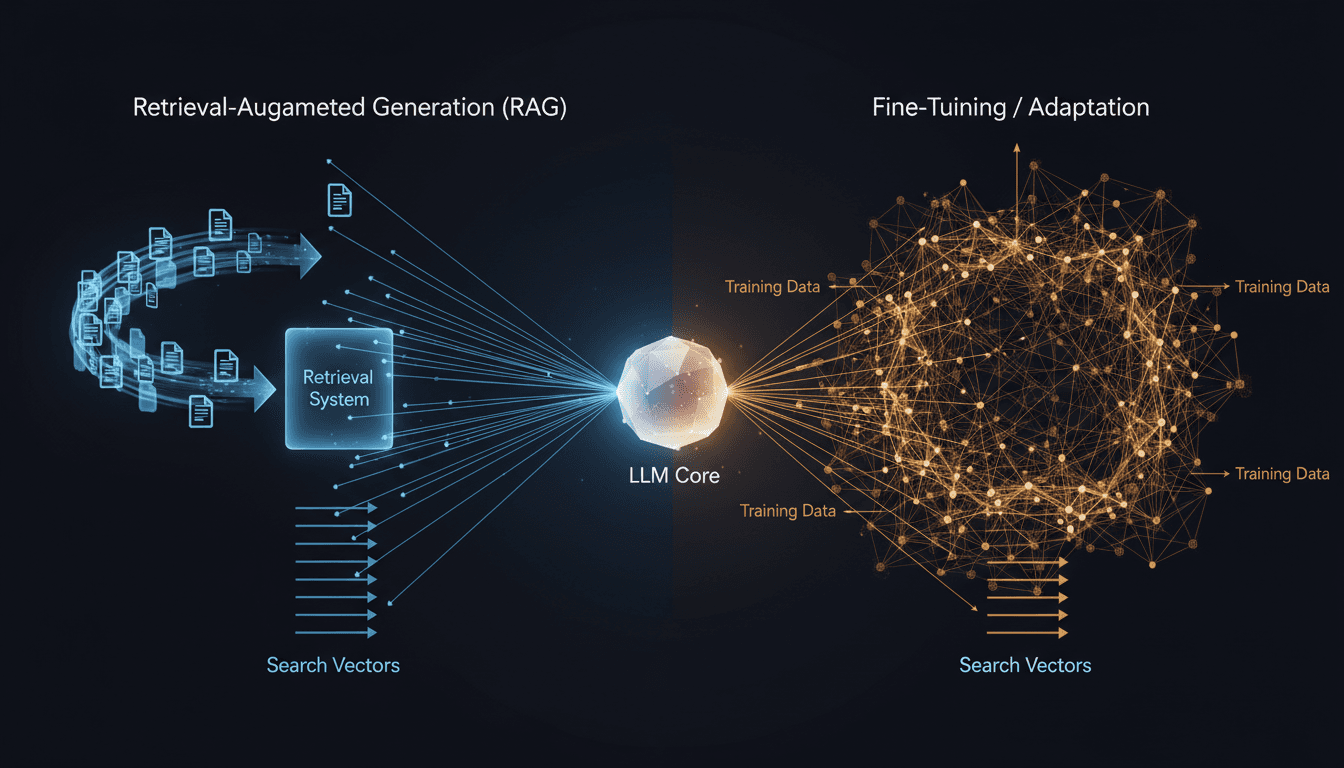
RAG vs. Fine-Tuning: Navigating the Best LLM Customization Path for Your Enterprise AI

Retrieval-Augmented Generation (RAG) and fine-tuning stand out as two potent strategies for tailoring large language models (LLMs) to meet the unique demands of enterprises. Partnering with AI-native digital transformation services ensures you harness the optimal method, whether it's for real-time data access or cultivating deep domain expertise. This guide will unpack RAG and fine-tuning, illuminate their mechanics and advantages, pit them against each other across key dimensions, and present a framework for making your choice based on data volatility, latency needs, budget constraints, and compliance mandates. We'll also explore hybrid architectures, showcase mission-critical use cases, and outline the essential metrics for gauging success.
What Exactly Is Retrieval-Augmented Generation (RAG) and How Does It Elevate Enterprise AI?
Retrieval-Augmented Generation masterfully blends the retrieval of external knowledge with LLM inference, significantly boosting accuracy, traceability, and the currency of responses within enterprise applications. By integrating a sophisticated retriever component and a vector database with a pre-trained model, RAG effectively curbs hallucinations and supports the seamless integration of real-time information into domain-specific workflows.
Retrieval-Augmented Generation for Enterprise AI
RAG merges external knowledge retrieval with LLM inference to sharpen accuracy and deliver up-to-the-minute responses in enterprise applications. This method is key to minimizing hallucinations and enabling real-time information updates.
This foundational research provides the bedrock for understanding RAG, a central element in our discussion on customizing LLMs for enterprise environments.
How Do RAG, Large Language Models, and Vector Databases Work in Tandem?
RAG pipelines orchestrate three core components—the retriever, the vector database, and the generator—to dynamically fetch relevant information and enrich the prompt before generating output. The retriever translates user queries into embeddings, the vector database surfaces the top-k most similar documents, and the generator leverages this retrieved context to craft precise answers. This architecture facilitates continuous knowledge updates and elegantly decouples sensitive data storage from model parameters.
What Are the Core Advantages of RAG for Enterprise AI Solutions?
Integrating a retrieval layer into LLM workflows unlocks a cascade of benefits:
- Enhanced data currency through dynamic access to external knowledge repositories.
- Reduced hallucinations by grounding responses in verified source documents.
- Improved traceability with clear attribution to retrieved passages.
- Strengthened data privacy, as proprietary records remain securely segregated.
- Effortless integration with existing enterprise search platforms and knowledge graphs.
These advantages pave the way for greater user trust and accelerated adoption of LLM-powered applications that demand unwavering accuracy and strict compliance.
What Hurdles and Limitations Should Enterprises Anticipate with RAG?
While RAG significantly bolsters reliability, it also introduces complexities in implementation and ongoing management:
- Increased infrastructure demands for managing vector databases and embedding servers.
- A critical dependency on data quality and the performance of embedding models for retrieval accuracy.
- Potential latency increases when fetching and processing external documents at query time.
- Scalability challenges as knowledge bases expand into billions of vectors.
- The necessity for rigorous data governance to maintain current and secure retrieval indices.
Carefully weighing these challenges against the advantages of real-time access sets the stage for a thorough evaluation of fine-tuning alternatives.
What Is LLM Fine-Tuning and Why Is It Indispensable for Enterprise AI Customization?
Fine-tuning customizes a pre-trained LLM for specialized tasks by training it on domain-specific datasets, thereby elevating its performance in niche applications. This meticulous process refines the model's parameters, aligning its output style, tone, and knowledge scope precisely with enterprise requirements and regulatory frameworks.
Fine-tuning Large Language Models
Fine-tuning adapts pre-trained LLMs for specialized tasks by training on domain-specific datasets, boosting performance in niche applications. This process refines model parameters and aligns the LLM’s output with enterprise needs.
This seminal paper offers crucial background on the BERT model, a foundational element for many fine-tuning applications discussed herein.
How Does Fine-Tuning Adapt Pre-Trained Models for Specific Domain Needs?
Fine-tuning involves adjusting the weights of a base LLM using a carefully curated corpus of domain-specific texts. Techniques range from comprehensive parameter updates to more efficient methods like LoRA and prefix-tuning. By training on meticulously labeled examples—such as product manuals, legal contracts, or medical records—the LLM learns to generate highly accurate, contextually relevant responses tailored precisely to the enterprise’s subject matter.
What Are the Key Advantages of Fine-Tuning for Enterprise AI Applications?
Fine-tuned models deliver a distinct set of benefits:
- Deep Domain Expertise: Outputs reflect highly precise knowledge and industry-specific terminology.
- Consistent Brand Voice and Tone: Ensures uniform messaging across all customer interactions.
- Optimized Inference Speed: Embeds domain logic directly into the model for lightning-fast responses.
- Reduced External Dependencies: Minimizes reliance on external retrieval infrastructure in environments with static knowledge.
These advantages streamline workflows for tasks such as automated report generation, sophisticated sentiment analysis, and precise regulatory drafting.
What Are the Common Challenges and Costs Associated with Fine-Tuning?
Enterprises must carefully consider.
- Extensive data preparation, meticulous annotation, and rigorous quality validation.
- Substantial compute resources and specialized hardware requirements for training.
- The inherent risk of overfitting on limited domain data, necessitating continuous retraining.
- Potential model drift as real-world knowledge evolves, requiring robust update pipelines.
- A higher carbon footprint and increased operational expenses compared to inference-only methods.
A clear understanding of these trade-offs is crucial for making an informed decision between fine-tuning, RAG, or a hybrid strategy. For enterprises building production ML pipelines, our guide on MLOps best practices and the 12 controls you need covers the governance framework to keep models reliable at scale.
How Do RAG and Fine-Tuning Stack Up: A Deep Dive into Enterprise AI Model Optimization?
RAG and fine-tuning diverge across several critical dimensions essential for enterprise deployment. The table below offers a direct comparison of their attributes to guide you toward the optimal customization strategy. Before diving in, remember: RAG excels in dynamic environments, while fine-tuning shines in static, specialized domains.
What Is the Enterprise AI Decision Framework for Selecting Between RAG and Fine-Tuning?
A structured decision framework allows for a thorough evaluation of critical factors—data volatility, domain specificity, latency requirements, budget, and compliance—to pinpoint the most effective LLM customization approach. The following checklist is designed to guide enterprise architects through each crucial criterion.
- Data Volatility: Opt for RAG if knowledge updates weekly or daily; choose fine-tuning for static content updated quarterly or less frequently.
- Domain Specificity: Favor fine-tuning when outputs demand deep subject-matter expertise and a consistently precise tone.
- Latency Requirements: Select fine-tuning if sub-200ms inference latency is non-negotiable; utilize RAG when a 500ms tolerance is acceptable.
- Budget & Resources: Carefully balance the pay-per-query costs of RAG against the capital expenditures associated with training clusters.
- Regulatory Compliance: Employ RAG to maintain sensitive records externally; proceed with fine-tuning only if encryption and audit controls meet stringent standards.
- Infrastructure Maturity: Leverage existing search and vector database capabilities for RAG; rely on established MLOps pipelines for fine-tuning.
- Explainability & Traceability: Utilize RAG to clearly attribute answers to their original sources; opt for fine-tuning when consistent, self-contained outputs are paramount.
How Do Data Volatility and Domain Specificity Shape Your Choice?
High data volatility necessitates RAG’s live retrieval capabilities to guarantee accuracy, whereas stable, specialized domains benefit from the self-contained knowledge base of a fine-tuned model. Aligning data change frequency with appropriate update mechanisms is key to preserving output relevance and minimizing retraining overhead.
What Role Do Latency Requirements and Infrastructure Play in the Decision?
When sub-200ms response times are critical for customer-facing applications, fine-tuned models offer superior inference latency. If your existing infrastructure already incorporates vector search clusters and parallel embedding services, RAG becomes a highly cost-effective solution, even with slightly longer query delays.
How Should Budget, Resources, and Compliance Influence Your Decision?
Enterprises with constrained training budgets or lacking dedicated GPU clusters often gravitate towards RAG to circumvent the substantial costs of fine-tuning cycles. Conversely, organizations equipped with ample compute resources may find investing in fine-tuning yields lower per-query costs over the long term. Compliance teams typically favor RAG architectures that ensure proprietary data remains within secure, controlled storage environments.
Can a Structured Checklist or Decision Tree Streamline This Process?
Developing a visual decision tree with clear yes/no branches can significantly enhance stakeholder alignment and expedite the procurement process. Embedding key thresholds—such as update frequency and latency tolerance—directly into the tree ensures rapid method selection during architecture reviews.
How Can Hybrid Approaches Seamlessly Blend RAG and Fine-Tuning for Peak Enterprise AI Performance?
Hybrid customization strategies ingeniously combine the strengths of both RAG and fine-tuning, enabling enterprises to achieve both deep domain expertise and real-time knowledge updates concurrently. By fine-tuning a base LLM on core content and then layering RAG for peripheral or evolving data, organizations can construct a truly balanced and powerful solution.
Hybrid Approaches for LLM Customization
Hybrid customization masterfully leverages the combined strengths of RAG and fine-tuning to achieve both domain expertise and live knowledge updates simultaneously. This integrated approach maximizes the benefits of both methods for optimal outcomes.
This comprehensive survey offers valuable insights into hybrid approaches, which are pivotal for maximizing consistency and data freshness in enterprise AI services.
What Are the Advantages of Integrating RAG with Fine-Tuning?
Combining these two powerful methods yields significant advantages:
- Enhanced domain-tuned model performance on core tasks.
- Live retrieval capabilities for dynamic policies, regulations, or product catalogs.
- Substantially reduced hallucinations by anchoring less stable content to retrieved sources.
- Decreased retraining frequency, leading to considerable operational cost savings.
- Improved scalability by delegating static knowledge to the model and dynamic knowledge to the retrieval system.
This synergistic hybrid pattern optimizes both consistency and data currency in enterprise AI services.
What Architectural Patterns Support Hybrid LLM Customization Effectively?
Common and effective hybrid blueprints include:
- Dual-Encoder Pipeline: A fine-tuned LLM generates core responses, while a parallel RAG pipeline supplements with retrieved context when queries fall outside the fine-tuned domain’s scope.
- Cascading Logic: Requests are initially routed to the fine-tuned model; a fallback to RAG is triggered when confidence scores dip below a predefined threshold.
- Ensemble Generation: Outputs from a specialized fine-tuned model and a retrieval-augmented model are combined, often through weighted blending, to enhance overall accuracy.
These sophisticated patterns empower engineering teams to strike an optimal balance between throughput, accuracy, and ongoing maintenance effort.
How Do Hybrid Models Effectively Address Real-Time Updates and Domain Expertise?
In a well-architected hybrid setup, static domain knowledge is expertly embedded within the fine-tuned LLM, ensuring unwavering consistency in style and profound expertise. Concurrently, RAG dynamically fetches the latest figures, policy amendments, or breaking news to augment responses, enabling compliance-safe, up-to-the-minute information delivery without the need for extensive retraining cycles.
What Real-World Enterprise Use Cases Showcase the Success of RAG and Fine-Tuning?
Enterprises across diverse sectors are successfully implementing both RAG and fine-tuning strategies to achieve critical business objectives. The following list highlights key applications demonstrating their impact:
- Customer Service: RAG powers intelligent chatbots that retrieve policy documents in real time to swiftly resolve inquiries, dramatically reducing resolution times and support costs.
- Legal Research: Fine-tuned models excel at generating precise contract summaries and risk assessments, consistently adhering to legal terminology and professional tone.
- Healthcare Diagnostics: Hybrid systems deliver diagnostic suggestions grounded in a fine-tuned medical knowledge base, while simultaneously pulling the latest clinical guidelines via RAG.
- Financial Advisory: Fine-tuning on historical market data enables the generation of highly tailored investment recommendations, and RAG integrates real-time market feeds for timely, actionable insights.
These compelling examples underscore how customized LLMs are driving unprecedented levels of efficiency, accuracy, and compliance within regulated industries.
How Are RAG and Fine-Tuning Applied Across Customer Service, Legal, and Healthcare Sectors?
In customer service, RAG chatbots seamlessly integrate with knowledge management systems to instantly retrieve product manuals, policy pages, and troubleshooting guides. Legal teams embed vector databases of case law and statutes, enabling RAG-augmented LLMs to cite specific articles with precision. Healthcare providers leverage RAG to retrieve peer-reviewed research and current guidelines at query time, providing crucial support for clinical decision-making.
How Does Fine-Tuning Enhance Financial Advisory and Text Summarization Capabilities?
Financial institutions fine-tune LLMs on proprietary trading data and regulatory filings to generate compliant reports and sophisticated predictive analyses. Media organizations adapt models on their specific editorial guidelines and extensive corpora of past articles to produce consistent, on-brand summaries and compelling headlines.
What Hybrid Implementations Exemplify Best Practices and Deliver Outstanding Outcomes?
A leading global insurer fine-tuned an LLM on intricate policy conditions for streamlined renewal workflows, while simultaneously layering RAG to incorporate emerging regulatory bulletins. This sophisticated hybrid solution slashed policy processing times by an impressive 40 percent and ensured unwavering compliance during regulatory updates, all without requiring model retraining.
How Do You Measure Success and ROI for RAG and Fine-Tuning in Enterprise AI Initiatives?
Effectively evaluating the impact of LLM customization necessitates meticulous tracking of performance, efficiency, and key business metrics. A well-defined set of Key Performance Indicators (KPIs) and robust tooling enable continuous improvement and stringent governance.
What KPIs Are Absolutely Essential for Tracking LLM Customization Effectiveness?
Core KPIs encompass model accuracy, latency, and hallucination frequency, augmented by data pipeline observability indicators that ensure end-to-end data integrity. Crucially, business metrics—such as support ticket deflection rates or report turnaround times—translate technical advancements into tangible ROI.
How Do Data Observability and MLOps Impact Long-Term Model Performance?
Robust MLOps pipelines, complete with rigorous data quality validations and comprehensive lineage tracking, are indispensable for preventing model drift and sustaining reliable performance over time. Observability platforms are vital for detecting anomalies in input distributions and alerting teams to initiate retraining or index refresh operations, thereby ensuring LLM outputs remain consistently trustworthy.
What Tools and Metrics Support Continuous Improvement and Regulatory Compliance?
Enterprises leverage integrated dashboards that combine insights from Google Search Console for query patterns, application performance monitoring for latency analysis, and specialized MLOps suites (e.g., MLflow, Kubeflow) for meticulous experiment tracking. Automated compliance audits reference source attributions in RAG outputs and meticulously log encryption details for fine-tuned model deployments.
Embracing these advanced tools and metrics cultivates a culture of data-driven optimization, reinforcing both technical excellence and unwavering regulatory adherence. Explore our applied AI intelligence solutions to see how Future.Works helps enterprises deploy production-grade LLM systems, or book a free strategy sprint to evaluate your RAG and fine-tuning options.