.svg&w=256&q=75)


Supply Chain Control Tower: How AI Delivers End-to-End Visibility
Supply chain disruptions are no longer exceptional events. They are the operating environment. From geopolitical conflicts rerouting shipping lanes to climate events shutting down production hubs, enterprises need visibility that extends beyond their own four walls. The supply chain control tower -- powered by AI and real-time data integration -- is how leading organizations are achieving that visibility and turning it into competitive advantage.
This guide covers the architecture, integration patterns, and implementation strategy for building an AI-powered control tower that moves beyond dashboards into predictive and prescriptive decision-making.
What a Supply Chain Control Tower Actually Is
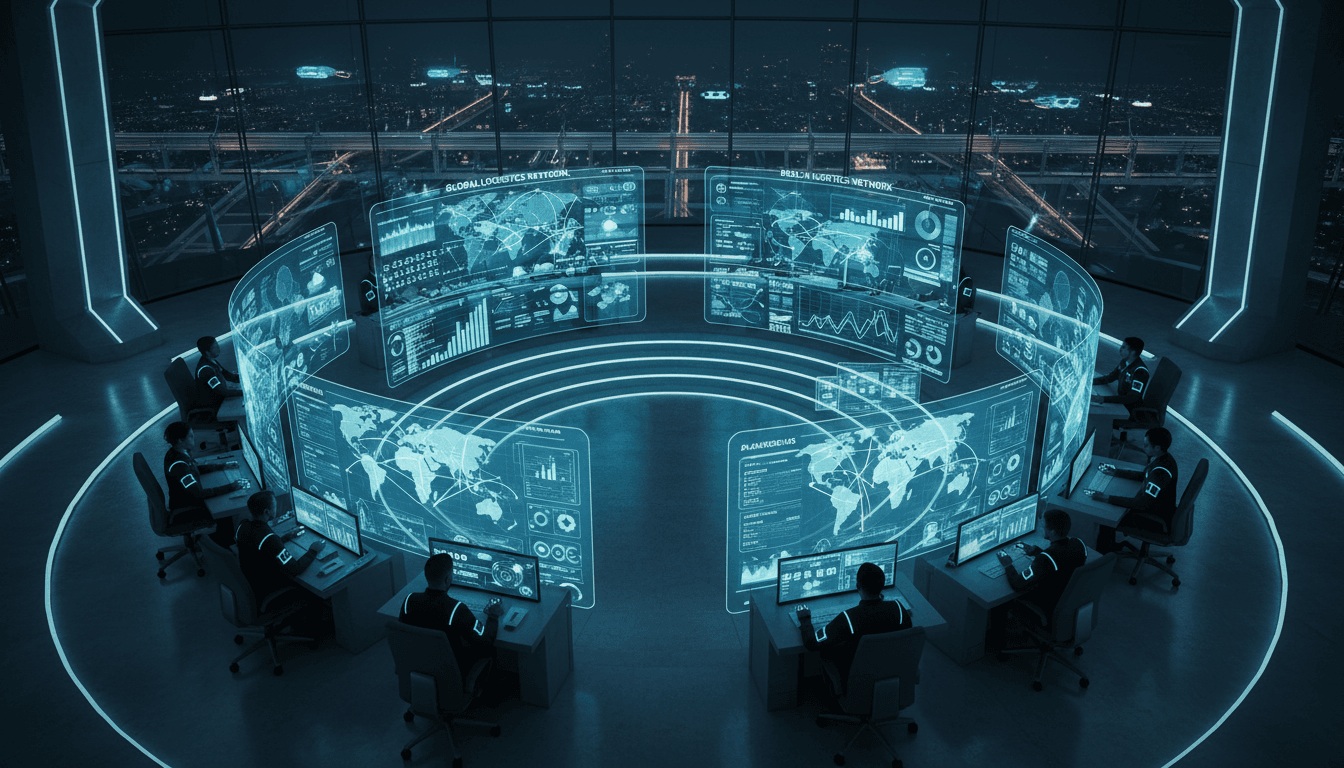
A supply chain control tower is a centralized capability -- part technology platform, part operating model -- that provides end-to-end visibility across procurement, manufacturing, logistics, and distribution. It aggregates data from internal systems and external sources, applies analytics to detect patterns and anomalies, and enables coordinated decision-making across functional silos.
The term has been used loosely across the industry, so it is worth being precise about what separates a genuine control tower from a BI dashboard with a new label:
- Scope: A control tower spans the entire supply chain, not just logistics or warehousing. It connects tier-2 suppliers to last-mile delivery.
- Timeliness: It operates on real-time and near-real-time data, not batch reports. The value degrades quickly when data is stale.
- Intelligence: It does not just display data. It detects anomalies, predicts disruptions, recommends actions, and in mature implementations, executes decisions autonomously within defined guardrails.
- Cross-functional coordination: It breaks down the walls between procurement, manufacturing, logistics, and commercial teams by providing a shared operational picture.
The Four-Layer Architecture
A well-designed control tower consists of four distinct layers, each with specific technology requirements and integration patterns.
Layer 1: Data Ingestion and Harmonization
The foundation layer collects, normalizes, and stores data from dozens or hundreds of sources. This is where most implementations struggle, because supply chain data is notoriously fragmented, inconsistent, and often trapped in legacy systems.
Key data sources include:
- Internal transactional systems: ERP (SAP, Oracle, Microsoft Dynamics), WMS (Manhattan, Blue Yonder), TMS (Oracle Transportation, SAP TM)
- Supplier data: Purchase orders, advance ship notices, quality certificates, capacity commitments
- Logistics providers: Carrier tracking APIs, ocean container tracking (via AIS data), air cargo milestones
- External intelligence: Weather feeds, port congestion data, commodity pricing, geopolitical risk indices, demand signals from POS or e-commerce platforms
- IoT and sensor data: Temperature monitors, GPS trackers, machine telemetry from production lines
The architecture pattern that works best here is an event-driven data mesh. Each data domain (procurement, logistics, manufacturing) owns its data products and publishes events to a shared event bus. A central harmonization layer maps these events to a canonical data model and stores them in a time-series optimized data store.
The single biggest predictor of control tower success is the quality of the data ingestion layer. Organizations that underinvest here build impressive-looking dashboards on unreliable foundations.
Layer 2: ML Inference and Analytics Engine
This layer transforms raw data into actionable intelligence. It runs three classes of analytics, each progressively more valuable:
Descriptive analytics answer the question "what is happening now." This includes real-time order status, inventory positions across all nodes, in-transit visibility, and supplier performance metrics. Most organizations stop here and call it a control tower. It is not -- it is a visibility platform.
Predictive analytics answer "what is likely to happen." This is where machine learning delivers transformative value:
- Demand sensing: ML models that combine historical demand, promotional calendars, weather data, and macroeconomic indicators to predict demand at SKU-location level with significantly higher accuracy than statistical forecasting
- Disruption prediction: Models trained on historical disruption patterns, weather forecasts, port congestion data, and geopolitical risk signals to flag potential supply interruptions days or weeks before they materialize
- Lead time prediction: Dynamic lead time models that account for supplier performance variability, carrier transit time distributions, and customs clearance patterns
- Quality prediction: Models that correlate supplier process parameters, raw material characteristics, and environmental conditions with downstream quality outcomes
Prescriptive analytics answer "what should we do about it." This layer uses optimization algorithms and simulation to recommend specific actions:
- Optimal inventory rebalancing across distribution nodes
- Alternative sourcing recommendations when a primary supplier is at risk
- Dynamic routing and carrier selection based on predicted transit times and cost
- Production schedule adjustments that minimize the impact of supply disruptions on customer commitments
Layer 3: Decision Orchestration
The orchestration layer is what separates a control tower from an analytics platform. It manages the workflow of detecting a situation, evaluating options, making a decision, and executing that decision across systems.
This layer operates on three tiers of automation:
- Human-in-the-loop: The system recommends actions and presents them to a planner or supply chain manager for approval. Appropriate for high-value, high-uncertainty decisions.
- Human-on-the-loop: The system executes decisions autonomously but notifies a human who can override within a defined window. Appropriate for routine decisions with moderate impact.
- Fully autonomous: The system executes decisions without human intervention, within defined guardrails. Appropriate for high-frequency, low-impact decisions like inventory replenishment within safety stock parameters.
The key architectural component here is a decision rules engine that codifies business policies, approval thresholds, and escalation criteria. This engine must be configurable by business users, not hard-coded by developers, because the rules change frequently as business conditions evolve.
Layer 4: Visualization and Collaboration
The presentation layer provides role-specific views of the supply chain:
- Executive dashboards: KPI summaries, risk heat maps, financial impact projections
- Planner workbenches: Detailed operational views with drill-down capability, scenario comparison tools, and action execution interfaces
- Supplier portals: Shared visibility into forecasts, orders, and performance metrics
- Alert management: Configurable notification workflows that route alerts to the right person based on severity, geography, and product category
The visualization layer should be built on a real-time data streaming architecture, not a polling or refresh model. Planners need to see changes as they happen, not when they remember to click refresh.
Integration Patterns That Work at Scale
The control tower's value is directly proportional to the breadth and depth of its integrations. Here are the patterns that work in enterprise environments:
API-first integration for modern cloud systems. Use REST or GraphQL APIs with proper authentication, rate limiting, and error handling. Prefer event-driven webhooks over polling where available.
EDI and B2B gateway integration for supplier and logistics partner data. Many supply chain partners still operate on EDI (ANSI X12, EDIFACT). A B2B gateway that translates EDI messages into your canonical event format is essential.
Database replication for legacy ERP systems that lack modern APIs. Change data capture (CDC) tools like Debezium can stream changes from legacy databases without modifying the source system.
File-based integration as a last resort for partners who can only provide flat files. Automate ingestion with file watchers and validation rules, but invest in moving these partners to API-based integration over time.
IoT platform integration for sensor and telemetry data. Use MQTT or similar lightweight protocols for device-to-platform communication, with a streaming platform (Kafka, Pulsar) as the backbone.
Building the ROI Model
Quantifying control tower ROI requires measuring impact across multiple value levers:
- Inventory reduction: Better demand sensing and supply visibility enable lower safety stocks. Enterprises typically see reductions in the range of ten to twenty percent of buffer inventory within the first year.
- Expediting cost reduction: Predictive disruption alerts allow proactive mitigation instead of reactive expediting. Premium freight costs often drop meaningfully.
- Service level improvement: Better visibility and faster response to disruptions reduce stockouts and improve on-time-in-full (OTIF) delivery.
- Labor productivity: Automation of routine decisions frees planners to focus on exceptions and strategic work. The ratio of SKU-locations managed per planner can increase substantially.
- Revenue protection: Early warning of supply constraints enables proactive customer communication and alternative fulfillment, protecting revenue that would otherwise be lost to cancellations or substitutions.
Model these benefits conservatively and tie them to specific use cases in your phased implementation plan. Avoid the trap of building a single aggregate ROI number that cannot be traced back to measurable operational improvements.
Implementation Strategy: Start Narrow, Scale Fast
The most successful control tower implementations follow a phased approach:
Phase 1 (Months 1-3): Foundation and first use case. Stand up the data ingestion layer for one product line or supply chain segment. Implement real-time visibility and one predictive use case (typically demand sensing or disruption prediction). This phase validates the architecture and demonstrates value quickly.
Phase 2 (Months 4-6): Expand scope and add intelligence. Extend data coverage to additional product lines, suppliers, and logistics partners. Add prescriptive analytics for the highest-impact decision types. Begin building the decision orchestration layer.
Phase 3 (Months 7-12): Scale and automate. Roll out across the full supply chain. Implement autonomous decision-making for routine decisions. Integrate with supplier portals and customer-facing systems. Optimize ML models based on accumulated data.
Phase 4 (Ongoing): Continuous improvement. Add new data sources, refine models, expand automation scope, and extend the control tower to new business units or geographies.
The Organizational Model: Technology Alone Is Not Enough
A control tower is an operating model, not just a technology platform. The most common failure mode is building sophisticated technology without changing how decisions are made. Successful implementations require:
- A dedicated control tower team with cross-functional representation from procurement, manufacturing, logistics, and commercial
- Clear decision rights that define who can make which decisions and at what thresholds
- Process redesign that embeds control tower insights into daily planning and execution workflows
- Performance management that measures and rewards the behaviors the control tower enables
Getting Started
Building an AI-powered supply chain control tower is a significant undertaking, but the phased approach described above makes it manageable. The key is to start with a clear understanding of your highest-value use cases, invest heavily in the data foundation, and design the architecture for scale from day one.
If your supply chain spans multiple systems, geographies, and partners, intelligent systems integration is a critical enabler. The integration patterns and data architecture choices you make in the first phase will determine how easily you can scale.
Explore how Future.Works' services can accelerate your control tower implementation, or book a free Strategy Sprint to map out your supply chain visibility roadmap.
Related pages on Future Works: